
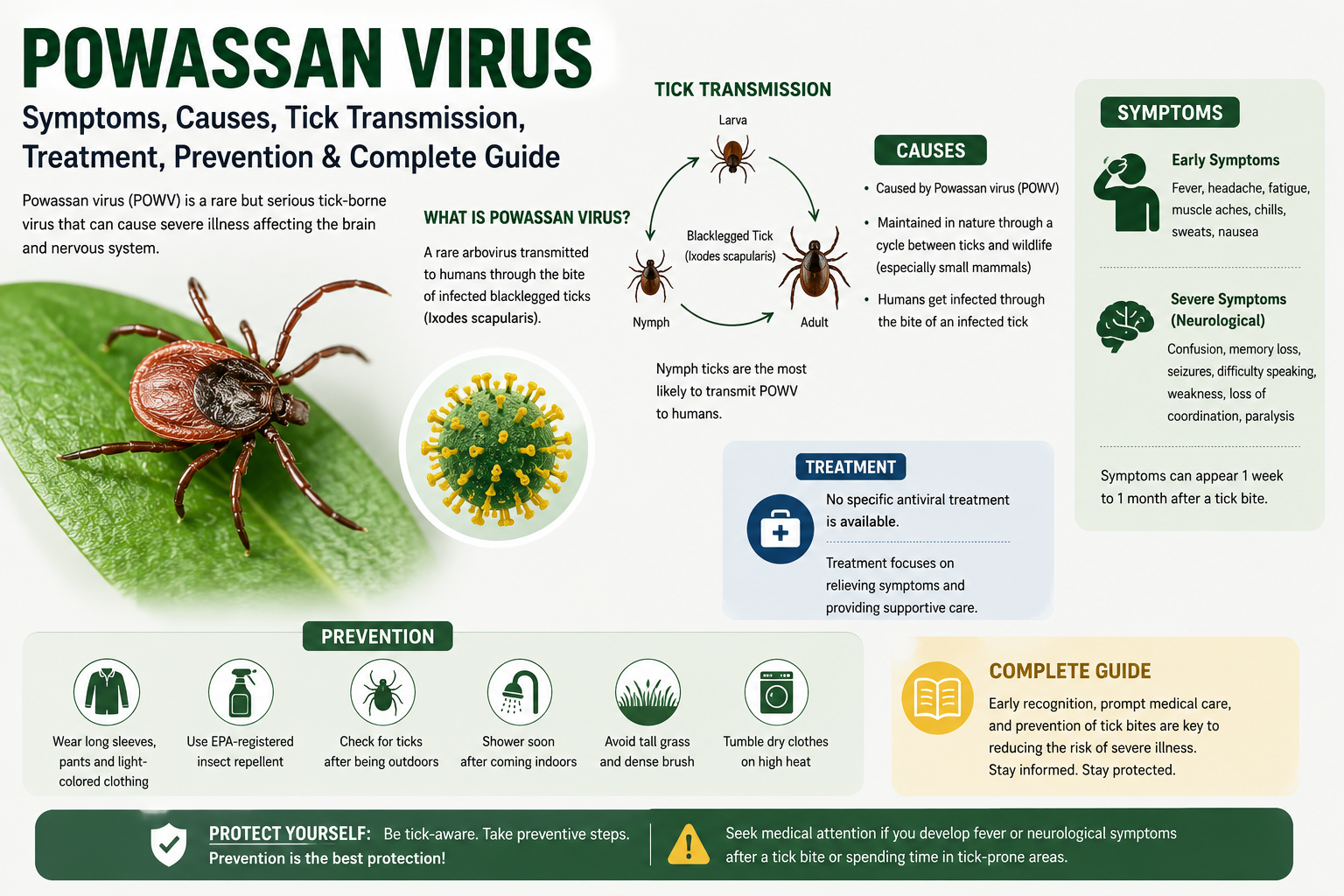
Introduction: Understanding the Emerging Threat of Powassan Virus (पोवासन वायरस का परिचय)
Imagine a pathogen so stealthy that it can be transmitted in just 15 minutes, potentially leading to permanent neurological damage or death. This is the reality of Powassan virus, a rare but increasingly concerning tick-borne disease. While still uncommon, cases are on the rise in North America, making awareness and prevention more critical than ever .
Powassan virus disease is caused by a virus spread through the bite of infected ticks . Unlike better-known tick-borne illnesses like Lyme disease, which typically require the tick to be attached for 24-48 hours, Powassan virus can be transmitted in as little as 15 minutes . This rapid transmission makes prompt tick removal and prevention crucial.
The virus is named after Powassan, Ontario, where it was first discovered in 1958, isolated from the brain of a young boy who tragically died from encephalitis . In recent years, reported cases have increased, with approximately 54 cases reported in the United States in 2024 alone, up from just a handful in previous decades . This guide provides a comprehensive overview of everything you need to know about Powassan virus, from its causes and symptoms to treatment options and, most importantly, how to protect yourself and your loved ones.
Chapter 1: What is Powassan Virus? (पोवासन वायरस क्या है?)
Powassan virus (POWV) is a rare but serious virus that belongs to the Flavivirus genus, a family that also includes well-known pathogens like dengue, Zika, West Nile, and yellow fever viruses . It is a tick-borne flavivirus, meaning it is primarily transmitted to humans and animals through the bite of infected ticks .
Two Lineages of the Virus
There are two distinct genetic lineages of Powassan virus that cause disease in humans, known as Lineage I and Lineage II .
- Lineage I (Powassan virus): This is the original virus discovered in 1958. It is primarily associated with tick species that rarely bite humans, such as the groundhog tick (Ixodes cookei) and the squirrel tick (Ixodes marxi) .
- Lineage II (Deer Tick Virus): This lineage is responsible for the vast majority of recent human cases in North America. It is spread by the black-legged tick or deer tick (Ixodes scapularis), the same tick that transmits Lyme disease . Because this tick commonly bites humans, Lineage II poses a more significant public health threat. While the two lineages differ at a genetic level, they are serologically indistinguishable and cause similar clinical symptoms in humans .
Related Searchable Keyword: Flavivirus (फ्लेवीवायरस) – This is a genus of viruses, many of which are arthropod-borne (transmitted by insects or ticks). Understanding this classification helps place Powassan virus in context with other mosquito and tick-borne illnesses.
Related Searchable Keyword: Tick-borne Encephalitis (TBE) (टिक–जनित एन्सेफलाइटिस) – Powassan virus is closely related to the tick-borne encephalitis virus found in Europe and Asia. Both can cause severe inflammation of the brain (encephalitis), but Powassan virus is the primary tick-borne flavivirus causing encephalitis in North America .
Chapter 2: Transmission: How Powassan Virus Spreads (संचरण)
Understanding how Powassan virus is transmitted is the first step in preventing infection.
The Tick Vector
The primary mode of transmission is through the bite of an infected tick. Powassan virus is maintained in an enzootic cycle, meaning it circulates in nature between ticks and small mammal hosts.
- The Cycle: Ticks become infected when they feed on the blood of infected animals, such as groundhogs, squirrels, mice, and other small rodents . The virus persists in the tick through its various life stages (larva, nymph, adult) in a process called transstadial transmission . Infected ticks can then pass the virus on to a new host, including humans, during a subsequent blood meal.
- The Vectors: Three main types of Ixodes ticks are known to carry and transmit Powassan virus :
- The black-legged tick or deer tick (Ixodes scapularis) is the primary vector for Lineage II (Deer Tick Virus) and is the most common tick to bite humans. Its expanding geographic range is a key factor in the rise of Powassan cases .
- The groundhog tick (Ixodes cookei) and squirrel tick (Ixodes marxi) are the primary vectors for Lineage I. However, these ticks rarely bite humans .
The Threat of Rapid Transmission
What makes Powassan virus particularly dangerous is the speed at which it can be transmitted . Unlike Lyme disease, where the bacteria reside in the tick’s gut and require a feeding period of 24-48 hours to be transmitted, Powassan virus is present in the tick’s saliva and can be transmitted within as little as 15 minutes of tick attachment . This means that even a brief encounter with an infected tick can lead to infection, and daily tick checks, while important, are not a guaranteed prevention measure.
Are Humans Dead-End Hosts?
Yes. While ticks can easily spread the virus to humans, people do not develop high enough levels of the virus in their blood to infect new ticks . Therefore, humans are considered “dead-end” hosts. The virus is not transmitted directly from person to person through casual contact. The only rare exception is through blood transfusion. Because of this, individuals diagnosed with Powassan virus infection are advised not to donate blood or bone marrow for 120 days following their illness .
Related Searchable Keyword: Ixodes Scapularis (आइक्सोड्स स्कैपुलरिस) – This is the scientific name for the black-legged or deer tick, the primary vector for Powassan virus (Lineage II) and Lyme disease in North America. Its widespread presence in wooded and grassy areas increases human exposure risk.
Chapter 3: Recognizing the Symptoms of Powassan Virus Disease (लक्षण)
Powassan virus disease can manifest in a wide range of symptoms, from no symptoms at all to severe, life-threatening illness .
The Incubation Period
If symptoms do develop, they typically appear within 1 week to 1 month (7 to 34 days) after the bite of an infected tick .
A Spectrum of Symptoms
The disease is often divided into two categories: asymptomatic/mild and severe.
Asymptomatic or Mild Infection
Many people who become infected with Powassan virus do not develop any symptoms or experience a mild, non-specific febrile illness that may go unnoticed . This is part of why the true incidence of the disease is likely underreported.
Severe Disease (Neuroinvasive Disease)
In some cases, the virus invades the central nervous system, leading to severe and potentially fatal diseases, including:
- Encephalitis (एन्सेफलाइटिस): Inflammation of the brain.
- Meningitis (मेनिनजाइटिस): Inflammation of the membranes surrounding the brain and spinal cord.
Initial Symptoms: For those who develop severe disease, early symptoms can include :
- Fever
- Headache
- Vomiting
- Weakness
Severe Symptoms: As the disease progresses to affect the central nervous system, symptoms can escalate to include :
- Confusion and disorientation
- Loss of coordination and muscle weakness
- Difficulty speaking or slurred speech
- Seizures
- Paralysis
- Tremors
Long-term Consequences and Fatality:
The consequences of severe Powassan virus disease can be devastating. Approximately half (50%) of survivors experience permanent neurological problems . These long-term health issues can include:
- Recurring headaches
- Muscle wasting and loss of strength
- Memory problems and cognitive difficulties
Furthermore, the disease carries a significant mortality rate. Approximately 10% of severe cases are fatal .
Related Searchable Keyword: Encephalitis (एन्सेफलाइटिस) – This is the inflammation of the brain, often caused by viral infections. It is a hallmark of severe Powassan virus disease and can lead to serious neurological complications. Understanding this term is vital for recognizing the severity of the illness .
Chapter 4: Risk Factors and Affected Populations (जोखिम कारक)
Anyone can get Powassan virus disease if bitten by an infected tick, but certain factors increase the risk of both exposure and severe illness.
Geographic and Seasonal Risk
- Location: In the United States, most cases occur in the northeastern and Great Lakes regions . The geographic range is expanding, with cases now reported in at least 16 states .
- Seasonality: Ticks are most active during the warmer months. Therefore, most Powassan cases occur from late spring through mid-fall (April to September) .
Occupational and Lifestyle Risk
People who spend time outdoors in areas where infected ticks are present are at the highest risk of exposure. This includes :
- Outdoor workers (e.g., landscapers, forest rangers)
- Campers and hikers
- Gardeners
- People living in or near wooded and grassy areas
Risk of Severe Disease
While anyone who is infected can develop severe disease, certain groups are at higher risk for serious neurological complications :
- Older Adults: Individuals over the age of 60 are at a significantly greater risk of severe neurological deterioration and death .
- Children: Young children are also more vulnerable to severe outcomes.
- People with a Weakened Immune System: Those with compromised immune systems are less able to fight off the infection.
Related Searchable Keyword: Comorbidities (कॉमोरबिडिटीज़) – The presence of pre-existing medical conditions can increase the risk of complications from infections like Powassan. Individuals with underlying health issues are more susceptible to severe forms of tick-borne diseases.
Chapter 5: Diagnosis and Treatment (निदान और उपचार)
How is Powassan Virus Diagnosed?
Diagnosing Powassan virus disease can be challenging because its early symptoms are non-specific and resemble many other viral infections. A healthcare provider will typically make a diagnosis based on three key factors :
- Signs and Symptoms: An assessment of the patient’s clinical presentation.
- Exposure History: A history of the patient living in or traveling to an area where Powassan virus is known to circulate, and possible exposure to ticks.
- Laboratory Testing: Testing of blood or cerebrospinal fluid (CSF) is essential for confirmation. Most cases are diagnosed by serologic testing, which detects antibodies (IgM) that the immune system produces against the virus . Because the two virus lineages are serologically indistinguishable, the diagnosis is clinically reported as “Powassan virus infection” . PCR tests that detect viral RNA are also available but are most effective during the initial, short-lived viremic period, which often passes before symptoms emerge .
Treatment and Management
There are currently no specific antiviral medications or vaccines available to prevent or treat Powassan virus disease .
Treatment is entirely focused on supportive care and managing symptoms.
- For mild cases: Patients may be advised to rest, drink plenty of fluids, and use over-the-counter pain medications to alleviate fever and discomfort .
- For severe cases: Patients with encephalitis or meningitis often require hospitalization. Supportive care can include :
- Intravenous fluids to maintain hydration.
- Respiratory support (like a ventilator) for patients who have difficulty breathing.
- Medications to reduce swelling in the brain (cerebral edema).
- Anticonvulsant medications to manage seizures.
Related Searchable Keyword: Supportive Care (सहायक देखभाल) – This is the primary treatment for viral infections like Powassan, where no cure exists. It focuses on managing symptoms and providing relief to the patient while the body fights off the infection .
Chapter 6: Prevention is Your Best Defense (रोकथाम)
Since there is no cure or vaccine, preventing tick bites is the most critical strategy to protect yourself from Powassan virus .
Personal Protection Measures
1. Avoid Tick Habitats
Be aware of areas where ticks are likely to live, such as wooded, brushy, and grassy environments. When in these areas:
- Walk in the center of cleared trails.
- Avoid tall grass and overgrown vegetation.
2. Dress to Protect
- Wear Light-Colored Clothing: This makes it easier to spot ticks on your clothes .
- Tuck and Cover: Tuck your pants into your socks or boots, and tuck your shirt into your pants. This creates a physical barrier that prevents ticks from reaching your skin .
3. Use Insect Repellent
- Use EPA-registered insect repellents on exposed skin. Products containing DEET, picaridin, IR3535, or oil of lemon eucalyptus are effective .
- Treat clothing and gear with products containing 0.5% permethrin. This insecticide kills ticks on contact.
- Always follow the label instructions. Adults should apply repellent to children, avoiding their hands, eyes, and mouth .
4. Perform Tick Checks
- During Outdoor Activity: Check frequently for ticks on your clothing or skin. Brush off any ticks before they can attach .
- After Returning Indoors: Conduct a thorough full-body check for attached ticks. Pay special attention to hard-to-see areas such as the groin, armpits, and scalp . Use a mirror to check your back, or ask someone to help.
- Pets: Check your pets for ticks before they come inside, as they can bring ticks into your home .
Proper Tick Removal
If you find an attached tick, remove it promptly and correctly:
- Use Fine-Tipped Tweezers: Grasp the tick as close to the skin’s surface as possible .
- Pull Upward: Pull straight up with steady, even pressure. Do not twist or jerk the tick, as this can cause the mouthparts to break off and remain in the skin .
- Disinfect: After removing the tick, thoroughly clean the bite area and your hands with rubbing alcohol, an iodine scrub, or soap and water .
- Dispose of the Tick: You can flush it down the toilet or place it in a sealed bag/container and throw it away in the trash. You may also want to save it for identification by your local health department.
Important: Avoid using home remedies like petroleum jelly, nail polish, or a hot match to remove a tick. These methods are ineffective and can increase the risk of disease transmission by causing the tick to regurgitate saliva into the bite wound .
Frequently Asked Questions (FAQs) – अक्सर पूछे जाने वाले प्रश्न
Section 1: Basics of Powassan Virus (बुनियादी जानकारी)
Q1: What is Powassan virus?
A: Powassan virus is a rare but potentially serious tick-borne virus that can cause encephalitis (brain inflammation) and meningitis (inflammation of the membranes around the brain and spinal cord) in humans. It is named after the town of Powassan, Ontario, where it was first discovered in 1958 .
Q2: Where is Powassan virus found?
A: In North America, Powassan virus is most commonly found in the northeastern and Great Lakes regions of the United States. It has also been identified in parts of Canada. Cases have been reported in at least 16 U.S. states .
Q3: What does the name “Powassan” mean?
A: The virus is named after the town of Powassan, Ontario, Canada, where it was first discovered in 1958 when it was isolated from the brain of a young boy who died from encephalitis .
Q4: Is Powassan virus common?
A: No, it is still considered rare. However, reported cases have been increasing in recent years. In the United States, there are typically 20 to 40 cases reported per year, with 54 cases reported in 2024 . Because many infections are asymptomatic, the true number is likely higher.
Q5: Are there different types of Powassan virus?
A: Yes, there are two main lineages that cause human disease: Lineage I (the original Powassan virus) and Lineage II (deer tick virus). Lineage II is responsible for most recent cases in North America .
Section 2: Transmission (संचरण)
Q6: How is Powassan virus transmitted to humans?
A: Powassan virus is transmitted to humans primarily through the bite of an infected tick. It is not spread directly from person to person .
Q7: Can Powassan virus spread from person to person?
A: No, it does not spread through casual contact. The only rare exception is through blood transfusion. For this reason, infected individuals should not donate blood for 120 days .
Q8: Which ticks spread Powassan virus?
A: The black-legged tick, also known as the deer tick (Ixodes scapularis), is the primary vector for Lineage II. Groundhog ticks (Ixodes cookei) and squirrel ticks (Ixodes marxi) are associated with Lineage I but rarely bite humans .
Q9: How quickly can a tick transmit Powassan virus?
A: Unlike Lyme disease, Powassan virus can be transmitted in as little as 15 minutes after tick attachment because the virus is already present in the tick’s saliva .
Q10: Can animals spread Powassan virus directly to humans?
A: No. Animals are reservoirs for the virus, meaning ticks can pick it up from them, but they cannot directly infect humans. You get Powassan from a tick bite, not from contact with an animal .
Section 3: Symptoms (लक्षण)
Q11: What are the initial symptoms of Powassan virus disease?
A: Initial symptoms include fever, headache, vomiting, and weakness. These can appear anywhere from 1 week to 1 month after a tick bite .
Q12: What are the symptoms of severe Powassan virus disease?
A: Severe disease can cause confusion, loss of coordination, difficulty speaking, seizures, paralysis, and coma. It involves inflammation of the brain (encephalitis) or the membranes around it (meningitis) .
Q13: Can you have Powassan virus without symptoms?
A: Yes. Many people who become infected with Powassan virus do not develop any symptoms at all, or they experience only a mild, non-specific illness .
Q14: How soon after a tick bite do symptoms appear?
A: The incubation period is typically 1 week to 1 month (7 to 34 days) after the tick bite .
Q15: Does Powassan virus cause a rash?
A: A rash is not a typical symptom of Powassan virus disease, unlike Lyme disease, which is often characterized by a distinctive “bull’s-eye” rash.
Q16: What is the difference between Powassan and Lyme disease symptoms?
A: Powassan virus can cause severe neurological symptoms like confusion and seizures, while Lyme disease often begins with a rash, fever, and joint pain. Also, Powassan is transmitted much more quickly than Lyme .
Section 4: Risk and Severity (जोखिम और गंभीरता)
Q17: Who is most at risk of getting Powassan virus?
A: People who spend time outdoors in tick-infested wooded or grassy areas, especially in the northeastern and Great Lakes regions, are at the highest risk. This includes hikers, campers, and outdoor workers .
Q18: Who is most at risk for severe disease?
A: Older adults, children, and people with weakened immune systems are at a higher risk of developing severe neurological complications .
Q19: Is Powassan virus disease fatal?
A: Yes, it can be. Approximately 10% of severe cases of Powassan encephalitis are fatal .
Q20: What are the long-term effects of surviving Powassan virus disease?
A: Approximately 50% of survivors of severe disease experience permanent neurological problems, including recurrent headaches, memory loss, muscle wasting, and loss of strength .
Section 5: Diagnosis and Testing (निदान और परीक्षण)
Q21: How is Powassan virus diagnosed?
A: It is diagnosed through a combination of assessing signs and symptoms, evaluating the patient’s history of tick exposure, and conducting laboratory tests on blood or spinal fluid to detect antibodies .
Q22: What tests are used for Powassan virus?
A: The primary test is serology, which detects Powassan-specific IgM antibodies in serum or cerebrospinal fluid. Polymerase Chain Reaction (PCR) testing can also be used, but is most effective early in the infection .
Q23: Why is Powassan virus hard to diagnose?
A: Its early symptoms are similar to many other viral infections. Also, the PCR test window is short, and antibody tests may cross-react with other flaviviruses. Because of this, health providers often need to suspect and specifically test for it .
Q24: Where can I get tested for Powassan virus?
A: You should see your healthcare provider. They can order the necessary tests and send blood or spinal fluid samples to a state public health laboratory or the CDC for specialized testing .
Q25: Can I test for Powassan virus at home?
A: No. Testing requires specialized laboratory equipment and is not available as an over-the-counter home test.
Section 6: Treatment and Management (उपचार)
Q26: Is there a treatment for Powassan virus?
A: There is no specific antiviral medication or cure for Powassan virus disease. Treatment is supportive, aiming to relieve symptoms and manage complications .
Q27: What is supportive care for Powassan virus?
A: For mild cases, supportive care includes rest, fluids, and over-the-counter pain relievers. For severe cases, hospitalization is needed for IV fluids, breathing support, and medications to reduce brain swelling .
Q28: Will antibiotics help with Powassan virus?
A: No. Antibiotics are used to treat bacterial infections. Powassan is a viral infection, so antibiotics are not effective .
Q29: How long does it take to recover from Powassan virus?
A: Recovery can be prolonged and depends on the severity of the disease. Patients may experience long-term neurological issues that can last for months or years .
Q30: Can I get the same disease again if I had it before?
A: It is believed that having the infection once may provide immunity, but because it is so rare, long-term immunity is not well-studied. The best approach is to continue preventing tick bites.
Section 7: Prevention (रोकथाम)
Q31: What is the best prevention against Powassan virus?
A: The best prevention is avoiding tick bites. This includes wearing protective clothing, using insect repellent, and performing thorough tick checks after being outdoors .
Q32: Are there any vaccines for Powassan virus?
A: No, there are currently no vaccines available to prevent Powassan virus disease .
Q33: What insect repellent works against ticks?
A: Repellents containing DEET, picaridin, IR3535, or oil of lemon eucalyptus are effective. You can also treat clothing with permethrin .
Q34: Should I be concerned about ticks in my backyard?
A: Yes, ticks can be found in grassy and wooded areas, including your yard. Keeping your lawn mowed, removing leaf litter, and creating a barrier between your lawn and wooded areas can help reduce tick habitat .
Q35: How should I check myself for ticks?
A: Do a full-body check. Look in and around your hair and ears, under your arms, inside your belly button, around your waist, between your legs, and behind your knees. Use a mirror to check your back .
Q36: How do I properly remove a tick?
A: Use fine-tipped tweezers to grasp the tick as close to the skin as possible. Pull upward with steady, even pressure. Do not twist. Clean the bite area with rubbing alcohol or soap and water .
Q37: What should I NOT do to remove a tick?
A: Do not use home remedies like petroleum jelly, nail polish, or a hot match. These can cause the tick to regurgitate and increase the risk of infection .
Q38: Can I get Powassan virus from my pets?
A: You cannot get the virus directly from your pet. However, pets can bring infected ticks into your home and yard. Always check your pets for ticks after they’ve been outdoors .
Section 8: General and Miscellaneous (सामान्य और विविध)
Q39: Is Powassan virus related to the Zika virus?
A: Yes, both Powassan virus and Zika virus belong to the same family, Flaviviridae, and are part of the Flavivirus genus. However, Zika is primarily spread by mosquitoes, while Powassan is spread by ticks .
Q40: Why are Powassan virus cases increasing?
A: The rise in cases is likely due to several factors, including the expanding geographic range of the black-legged tick, increased awareness and surveillance by public health authorities, and more human exposure as populations move into wooded areas .
Conclusion: Staying Vigilant Against the Tick-Borne Threat
Powassan virus represents a growing, albeit still rare, public health concern in North America. Its ability to cause severe neurological disease, combined with its rapid transmission time and lack of specific treatment, makes it a pathogen to be taken seriously .
The key takeaways from this guide are:
- Severity: While many infections are asymptomatic, Powassan virus can lead to life-threatening encephalitis and permanent neurological damage .
- Rapid Transmission: Unlike Lyme disease, it can be transmitted in as little as 15 minutes, making prevention the most critical defense .
- Prevention is Vital: There is no cure or vaccine. Personal protection measures—such as wearing protective clothing, using insect repellent, and performing thorough tick checks—are essential for everyone spending time outdoors .
- Risk of Severe Disease: Older adults, children, and the immunocompromised are particularly vulnerable to the most severe outcomes of the infection .
By staying informed about the risks and consistently practicing tick prevention, you can significantly reduce your chances of contracting this serious virus. Awareness is your first and most powerful line of defense against Powassan virus.
Disclaimer: This article is for informational purposes only and does not constitute medical advice. Always consult a qualified healthcare professional for diagnosis, treatment, and personalized health recommendations.