
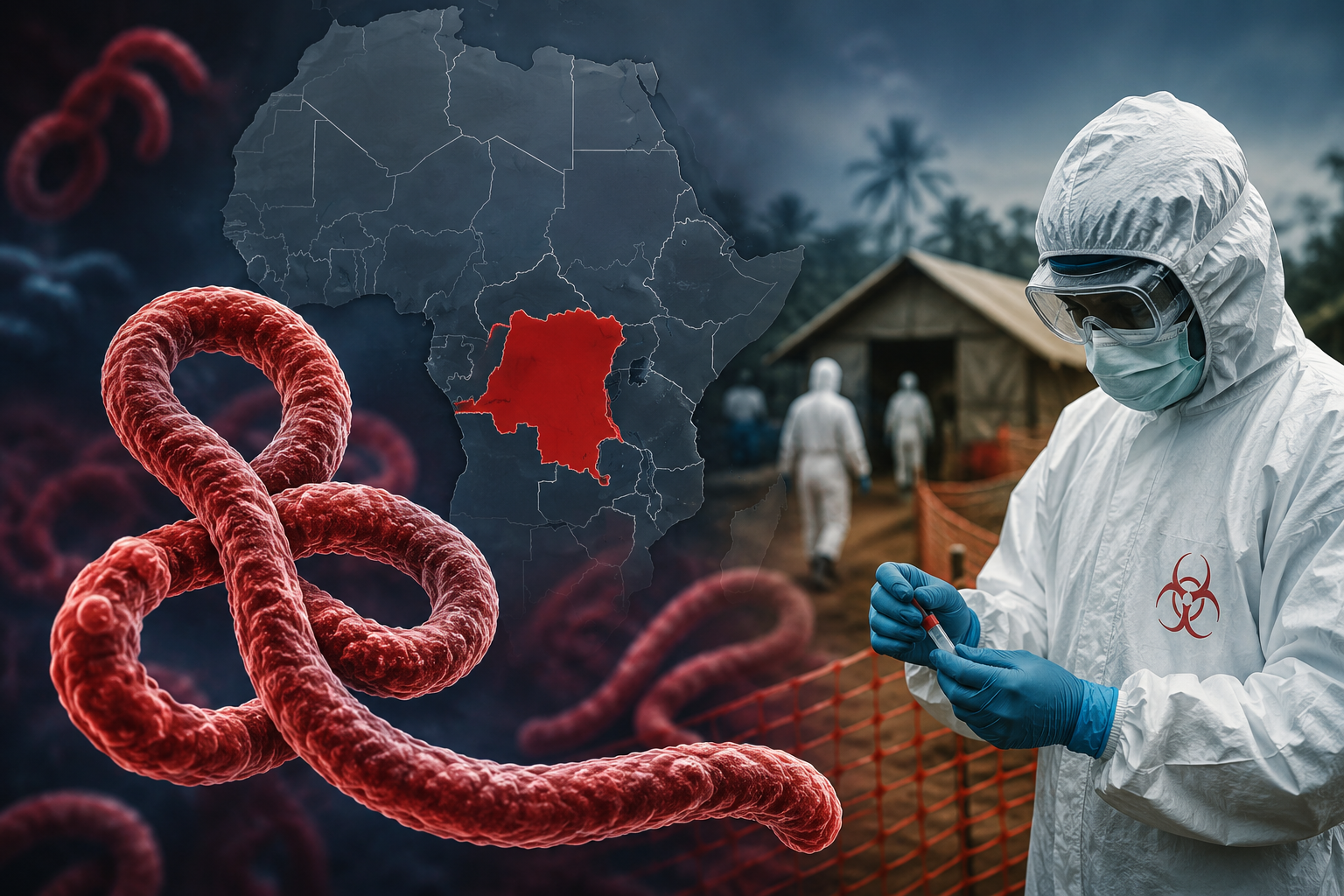
Introduction: The 2026 Ebola Crisis in the Democratic Republic of Congo (2026 में कोंगो में इबोला संकट)
The Democratic Republic of Congo is facing one of its most challenging Ebola outbreaks in history. Declared on May 15, 2026, this outbreak has rapidly evolved into a public health emergency of significant concern, driven by a rare strain of the virus for which there are no approved vaccines or specific treatments . As of mid-June 2026, the situation remains critical, with health authorities reporting a record one-day surge of 72 new cases, bringing the total number of confirmed cases to 782, including 181 confirmed deaths .
This outbreak is unfolding in eastern Congo’s Ituri province, a region already devastated by years of armed conflict, mass displacement, and humanitarian crisis . The convergence of a dangerous pathogen with a fragile health system and ongoing insecurity has created a perfect storm, making this one of the most complex Ebola outbreaks ever recorded. This comprehensive guide provides the latest information on the 2026 Congo Ebola outbreak, covering everything from the virus’s origins and transmission to symptoms, treatment, and prevention strategies.
Chapter 1: Understanding the Bundibugyo Strain – The Virus Behind the Outbreak (बुंदीबुग्यो वायरस: प्रकोप का कारण)
Unlike most previous Ebola outbreaks in Congo, which were caused by the Zaire ebolavirus, the 2026 outbreak is caused by the Bundibugyo virus, a rarer and less understood strain . This distinction is critical because there are no approved vaccines or specific therapeutics for this strain, significantly complicating the response effort .
What is the Bundibugyo Virus?
The Bundibugyo virus is one of six known species within the Ebolavirus genus. It was first identified in 2007 during an outbreak in Bundibugyo District, Uganda, which resulted in 149 cases and 37 deaths . Prior to 2026, the only other known outbreak of this strain occurred in the Democratic Republic of Congo in 2012, with 57 cases and 29 deaths . The current outbreak represents the third known significant outbreak of this rare strain.
The Challenge of an Unfamiliar Strain
The rarity of the Bundibugyo strain presents several challenges:
- No Approved Vaccines: The vaccines that have been instrumental in controlling previous Zaire ebolavirus outbreaks are not effective against the Bundibugyo strain .
- No Specific Therapeutics: There are no licensed antiviral drugs specifically approved for treating Bundibugyo virus disease. The World Health Organization has convened experts to prioritize candidate therapies, including monoclonal antibodies, for clinical trials .
- Diagnostic Limitations: Many of the available diagnostic tests are strain-specific. In the early days of the outbreak, the lack of diagnostic cartridges for the Bundibugyo strain delayed case confirmation .
- Less Understanding: Because there have been fewer outbreaks, the scientific and medical communities have less collective knowledge about the clinical course, transmission dynamics, and optimal management of this specific strain.
Related Searchable Keyword: Zaire Ebolavirus (जायर इबोलावायरस) – This is the most common and deadly Ebola strain, responsible for most major outbreaks, including the 2014-2016 West Africa epidemic. The existence of vaccines and therapeutics for this strain stands in stark contrast to the current Bundibugyo outbreak.
Related Searchable Keyword: Viral Hemorrhagic Fever (वायरल रक्तस्रावी बुखार) – This is a severe, multi-system syndrome characterized by fever, bleeding, and organ damage. Ebola is one of the most well-known viral hemorrhagic fevers, and understanding this broader category helps contextualize the severity of the disease.
Chapter 2: Causes and Transmission – How Ebola Spreads (कारण और संचरण)
Understanding the transmission of Ebola is critical for both personal protection and effective public health response. The virus spreads through direct contact with the bodily fluids of infected individuals or animals.
The Natural Reservoir
Ebola viruses are zoonotic, meaning they originate in animals. The natural reservoir for Ebola viruses is believed to be fruit bats, specifically species of the Pteropodidae family . The virus can be transmitted to humans through contact with infected bats or other wild animals that have become infected. Hunting, preparing, and consuming bushmeat from infected animals is a recognized route of spillover from animals to humans.
Human-to-Human Transmission
Once the virus enters the human population, it spreads through person-to-person contact. The primary routes of transmission include:
- Direct Contact with Bodily Fluids: Ebola is transmitted through direct contact with the blood, saliva, sweat, urine, feces, vomit, breast milk, and semen of an infected person .
- Contact with Contaminated Surfaces: The virus can survive on surfaces for a limited time. Touching objects (like bedding, clothing, or medical equipment) that have been contaminated with infected bodily fluids can lead to transmission.
- Burial Practices: Traditional burial practices, which often involve washing, touching, and preparing the body of the deceased, pose a high risk of transmission. This has been a significant challenge in the 2026 outbreak .
- Sexual Transmission: The virus can persist in semen for months after recovery, meaning sexual transmission is possible even after a person has recovered.
Key Characteristics of Spread
- Not Airborne: Unlike the flu or COVID-19, Ebola is not transmitted through the air. Transmission requires direct contact with infected fluids, making it easier to contain with proper hygiene and infection control measures .
- High Risk for Healthcare Workers: Healthcare workers are at elevated risk due to their proximity to infected patients and their bodily fluids. In the current outbreak, healthcare workers have been among the victims .
- Community Spread: The outbreak is spreading within communities, particularly in areas where there is mistrust of health authorities or where traditional practices increase risk. There have been reports of attacks on burial teams, which can further hamper response efforts .
Related Searchable Keyword: Zoonotic Disease (ज़ूनोटिक रोग) – A disease that can be transmitted from animals to humans. Ebola is a classic example of a zoonotic disease, originating in bats and then spreading to humans.
Related Searchable Keyword: Contact Tracing (संपर्क अनुरेखण) – This is a public health strategy where health workers identify and monitor everyone who has been in contact with a confirmed case. It is a cornerstone of Ebola containment, and a contact tracing rate of at least 90% is needed to control an outbreak .
Chapter 3: Recognizing the Symptoms of Ebola (इबोला के लक्षण)
Ebola virus disease is a severe, often fatal illness. Symptoms typically appear anywhere from 2 to 21 days after exposure to the virus, with an average of 8 to 10 days.
The Stages of the Disease
Early Symptoms (Non-Specific)
The early symptoms of Ebola are often non-specific and resemble many other common illnesses, such as malaria, typhoid, or influenza. This makes early diagnosis difficult and underscores the importance of testing.
Early signs can include:
- Sudden onset of fever
- Severe headache
- Muscle pain and weakness
- Fatigue
- Sore throat
- Joint pain
Progression to Severe Symptoms
As the disease progresses, the symptoms become more severe and distinct.
- Gastrointestinal Symptoms: Vomiting, diarrhea (often bloody), and abdominal pain are common. These symptoms can lead to severe dehydration.
- Hemorrhagic Symptoms: While not all patients experience bleeding, it is a hallmark of the disease. This can manifest as:
- Bleeding from the gums, nose, or eyes
- Blood in the stool or vomit
- Unexplained bruising
- A rash
- Redness in the eyes
Late-Stage and Critical Symptoms
In the most severe cases, the virus can lead to multiple organ failure, shock, and death.
- Multi-Organ Failure: The virus attacks multiple organs, including the liver and kidneys.
- Delirium and Shock: As organ function declines, patients may become confused, delirious, and ultimately go into shock.
- Death: Death often occurs due to a combination of severe dehydration, massive blood loss, and organ failure.
Related Searchable Keyword: Case Fatality Rate (सीएफआर या मृत्यु दर) – This is the proportion of people diagnosed with a disease who die from it. In the 2026 outbreak, the case fatality rate has fluctuated but has been reported around 23% . This is lower than some Zaire strain outbreaks (which have had rates up to 90%), but significantly higher than the 2012 Bundibugyo outbreak (where it was around 50%).
Related Searchable Keyword: Incubation Period (इन्क्यूबेशन पीरियड) – The time between exposure to a pathogen and the appearance of symptoms. For Ebola, this is 2 to 21 days, which is why contacts are monitored for a 21-day period.
Chapter 4: Risk Factors and Vulnerable Populations (जोखिम कारक)
The 2026 Ebola outbreak is not just a medical crisis; it is a complex humanitarian emergency with distinct risk factors and vulnerable populations.
Geographic and Conflict-Related Risk
- Location: The epicenter is Ituri province in eastern DRC, which accounts for more than 90% of the cases. Cases have also been recorded in neighboring North Kivu and South Kivu provinces, and the outbreak has spread across the border into Uganda .
- Conflict and Displacement: The outbreak is occurring in one of the most volatile regions in Africa, with many armed groups operating. Years of conflict have displaced nearly a million people in Ituri province alone, making contact tracing extremely difficult . People are constantly moving, often fleeing attacks, which helps the virus spread.
- Insecurity: Attacks on health workers and burial teams have been reported, hindering the response and creating fear . Distrust of outside authorities among the local population is a significant barrier .
Occupational and Lifestyle Risk
- Healthcare Workers: As mentioned, they are on the frontlines and at high risk of infection. Gaps in infection prevention and control in healthcare settings have been reported, leading to deaths among health workers .
- Traditional Healers and Burial Preparers: Those involved in traditional practices that involve contact with the deceased are at high risk.
- Hunters and Those Who Handle Bushmeat: Contact with infected animals is a risk for spillover events.
Vulnerable Populations
- People in Displacement Camps: Crowded, unsanitary conditions in camps for internally displaced people create ideal conditions for disease transmission.
- Children and the Elderly: These groups are often more vulnerable to severe disease.
- Pregnant Women: Ebola can be particularly dangerous during pregnancy.
Chapter 5: Diagnosis and Treatment (निदान और उपचार)
Rapid diagnosis and supportive treatment are critical for managing Ebola cases and preventing further transmission.
Diagnostic Challenges
Diagnosing Ebola, particularly in the early stages, is complicated by several factors.
- Non-Specific Symptoms: The early symptoms of fever, headache, and muscle aches mimic more common endemic diseases like malaria and typhoid . This means many people with fever are initially treated for other conditions.
- Strain-Specific Testing: The molecular diagnostics, such as Polymerase Chain Reaction (PCR) tests, are often strain-specific . Early in the 2026 outbreak, the limited availability of diagnostic cartridges for the Bundibugyo strain delayed confirmation of suspected cases.
- Laboratory Capacity: There have been reports of reagent shortages in laboratories, with hundreds of test results pending at various points in the outbreak .
Testing Procedures
To diagnose Ebola, a healthcare provider will:
- Assess Symptoms and Exposure History: They will ask about the patient’s symptoms and their recent travel history and potential contact with infected individuals.
- Perform Laboratory Tests: The definitive diagnosis is made through laboratory testing. This involves taking a small sample of blood and testing it for the virus’s genetic material (using PCR) or for antibodies against the virus.
Treatment: A Focus on Supportive Care
There is no cure for Ebola, and for the Bundibugyo strain, there are no specific licensed antiviral treatments . Treatment focuses on supportive care, which aims to relieve symptoms and support the body’s functions while it fights the infection.
- Hydration: Patients are given oral rehydration solutions or intravenous fluids to replace fluids lost through vomiting and diarrhea. This is one of the most critical components of treatment.
- Maintaining Oxygen Status: Providing oxygen to patients who have difficulty breathing.
- Treating Other Infections: Patients are susceptible to secondary bacterial infections, which can be treated with antibiotics.
- Pain Management: Medications are used to alleviate pain and fever.
The Search for Therapies
The scientific community is actively working to develop treatments for the Bundibugyo strain. The World Health Organization has convened experts to prioritize candidate therapies and diagnostics . Clinical trials for monoclonal antibodies and antiviral drugs like obeldesivir are being developed .
Related Searchable Keyword: Monoclonal Antibodies (मोनोक्लोनल एंटीबॉडी) – These are lab-made proteins that can mimic the immune system’s ability to fight off viruses. They are a promising area of research for Ebola and other infectious diseases and are being prioritized for clinical trials in the 2026 outbreak .
Related Searchable Keyword: Convalescent Plasma (कॉन्वेलसेंट प्लाज्मा) – This involves taking blood plasma from a patient who has recovered from Ebola and giving it to a sick patient. The recovered patient’s plasma contains antibodies that may help the sick patient fight the virus. It has been used in past outbreaks.
Chapter 6: The Latest 2026 Outbreak Updates (2026 के प्रकोप की ताज़ा जानकारी)
The 2026 Ebola outbreak in the DRC continues to evolve rapidly. This section provides the most current information based on updates from health authorities.
Cases and Fatalities
As of mid-June 2026, the situation is severe.
- Confirmed Cases: Health authorities have reported 782 confirmed cases in the DRC .
- Confirmed Deaths: The number of confirmed deaths has risen to 181 .
- Record Daily Surge: A record one-day surge of 72 new cases was reported on June 14, 2026, highlighting the continued rapid spread of the virus .
- Recoveries: A total of 56 people have recovered from the disease so far .
- Case Fatality Rate: The current fatality rate of the outbreak is 23%, though this figure can fluctuate .
Geographic Spread
- Epicenter: Ituri province remains the epicenter, accounting for more than 90% of cases .
- Expansion: The outbreak has spread to new health zones. On June 14, 2026, two new health zones were affected: Nia-Nia in Ituri province and Mabalako in North Kivu province . The total number of affected health zones across three provinces is now 31 .
- Border Spread: The outbreak has crossed into neighboring Uganda, where there have been confirmed cases and deaths .
Response Efforts and Challenges
The response is facing significant hurdles.
- Funding Shortfall: Health authorities have cited a funding gap of $21.5 million, which is affecting the capacity to respond .
- Overwhelmed Treatment Centers: Ebola treatment centers are overwhelmed, and many patients arrive in advanced stages of illness .
- Weak Contact Tracing: Contact tracing coverage has been a major concern. It has fluctuated, with reports of 56% to 62% coverage, far below the WHO’s target of 90% to 95% needed to control the outbreak .
- Logistical and Security Issues: Insecurity, community resistance, and logistical difficulties in remote areas continue to hamper the response .
- Healthcare Worker Strikes: There have been reports of nationwide indefinite strikes by doctors and medical staff, including in outbreak areas, demanding better pay and conditions .
Related Searchable Keyword: WHO Risk Assessment (WHO जोखिम आकलन) – The World Health Organization assesses the risk of an outbreak at the national, regional, and global levels. As of late May 2026, the WHO revised its assessment for the DRC to “very high” at the national level, “high” at the regional level, and “low” at the global level . This means the risk is extremely high for the DRC, significant for its neighbors, but low for the rest of the world.
Chapter 7: Prevention and Protection (रोकथाम और सुरक्षा)
Since there is no approved vaccine for the Bundibugyo strain, prevention relies entirely on avoiding exposure to the virus.
Personal Protective Measures
If you are in or traveling to an area affected by the outbreak, the following measures are essential:
- Avoid Contact with Infected Individuals: Stay away from anyone who is sick. If you must care for a sick person, wear appropriate personal protective equipment (PPE), including masks, gloves, and gowns.
- Avoid Contact with Bodily Fluids: Do not touch any bodily fluids of an infected person or a corpse.
- Avoid High-Risk Areas: Do not visit Ebola treatment centers unless absolutely necessary.
- Practice Good Hygiene: Wash your hands frequently with soap and water or use an alcohol-based hand sanitizer. Do not touch your eyes, nose, or mouth with unwashed hands.
- Avoid Contact with Dead Bodies: Traditional burial practices that involve touching the body are high-risk. Follow safe burial protocols established by health authorities.
- Avoid Bushmeat: Do not handle or eat bushmeat or any animal that might have been in contact with bats.
Community and Public Health Measures
- Participate in Contact Tracing: If you are identified as a contact of a confirmed case, cooperate with health authorities. Monitor your health for 21 days and immediately report any symptoms.
- Follow Public Health Guidelines: Adhere to the directives of the local health ministry and the WHO.
- Support Safe Burials: Allow health teams to conduct safe burials. These burials are designed to prevent the spread of the disease while respecting cultural practices as much as possible.
- Report Suspected Cases: If you or someone you know develops symptoms consistent with Ebola, contact the health authorities immediately.
Frequently Asked Questions (FAQs) – अक्सर पूछे जाने वाले प्रश्न
Section 1: The 2026 Outbreak (2026 का प्रकोप)
Q1: Where is the 2026 Ebola outbreak happening?
A: The outbreak is primarily in the Democratic Republic of Congo, in the eastern province of Ituri, which is the epicenter. Cases have also been reported in the neighboring North Kivu and South Kivu provinces, and the outbreak has spread to Uganda .
Q2: When did the 2026 Ebola outbreak start?
A: The outbreak was officially declared on May 15, 2026. However, it is believed that the virus had been circulating undetected for several weeks before the declaration, likely since early April .
Q3: How many cases and deaths have been reported so far?
A: As of mid-June 2026, there have been 782 confirmed cases and 181 confirmed deaths in the DRC . These numbers are constantly evolving.
Q4: What is the death rate of this outbreak?
A: The case fatality rate has been reported at 23%, but this can fluctuate .
Q5: Has the outbreak spread outside of Congo?
A: Yes, confirmed cases and deaths have been reported in neighboring Uganda .
Section 2: The Virus and Transmission (वायरस और संचरण)
Q6: What virus is causing the 2026 outbreak?
A: The outbreak is being caused by the Bundibugyo strain of the Ebola virus .
Q7: Is the Bundibugyo virus different from the Ebola virus?
A: Yes, it is one of the six known species of the Ebolavirus genus. It is distinct from the more common Zaire strain, which has caused most previous outbreaks .
Q8: Why is the Bundibugyo strain more dangerous in terms of the outbreak?
A: Because there are no approved vaccines or specific treatments for this strain, unlike the Zaire strain .
Q9: How is Ebola transmitted from person to person?
A: It spreads through direct contact with the blood, sweat, urine, feces, vomit, and other bodily fluids of an infected person, or with surfaces contaminated with these fluids .
Q10: Can Ebola spread through the air?
A: No, Ebola is not an airborne virus. It requires direct contact with infected bodily fluids .
Q11: How did the outbreak start initially?
A: It likely began with a spillover event from an animal host, most likely fruit bats, to a human .
Section 3: Symptoms (लक्षण)
Q12: What are the early symptoms of Ebola?
A: Early symptoms are non-specific and include sudden onset of fever, severe headache, muscle pain, weakness, and sore throat .
Q13: How long does it take for symptoms to appear after exposure?
A: The incubation period is 2 to 21 days, with an average of 8 to 10 days.
Q14: What are the later, more severe symptoms of Ebola?
A: Severe symptoms include vomiting, diarrhea (often bloody), and in some cases, bleeding from the gums, nose, or eyes. This can progress to multi-organ failure and shock .
Q15: Do all Ebola patients experience bleeding?
A: No, not all patients experience external bleeding. However, it is a hallmark of the disease.
Q16: What should I do if I develop symptoms of Ebola?
A: You should immediately isolate yourself from others and contact the local health authorities.
Section 4: Treatment and Response (उपचार और प्रतिक्रिया)
Q17: Is there a cure for Ebola?
A: There is no specific cure for Ebola. Treatment is supportive, focusing on managing symptoms like dehydration .
Q18: Are there vaccines for the Bundibugyo strain?
A: No, there are currently no approved vaccines for the Bundibugyo strain. This is one of the main challenges of the 2026 outbreak .
Q19: What are the main challenges in controlling this outbreak?
A: Key challenges include the lack of a vaccine, ongoing conflict and insecurity, community distrust, a funding gap, and weak contact tracing .
Q20: What is contact tracing and why is it important?
A: Contact tracing is finding and monitoring everyone who has been in contact with an infected person. It is crucial for breaking the chain of transmission, and the WHO recommends a 90-95% coverage rate .
Q21: Why is this outbreak so difficult to control?
A: It is occurring in a region with a severe humanitarian crisis, armed conflict, a population that is frequently displaced, and a high level of community mistrust. The logistical challenges in remote areas are also immense .
Q22: Has there been any international help?
A: Yes. The WHO, Africa CDC, and international organizations like Doctors Without Borders have deployed staff and resources to support the response . However, a significant funding gap remains .
Section 5: Prevention (रोकथाम)
Q23: How can I protect myself from Ebola?
A: Avoid contact with sick individuals and their bodily fluids, practice good hand hygiene, and avoid handling or eating bushmeat .
Q24: Are there any medicines I can take to prevent Ebola?
A: There is no approved post-exposure prophylaxis for the Bundibugyo strain, though clinical trials for some drugs are being developed .
Q25: Is it safe to travel to Africa during this outbreak?
A: The WHO’s global risk is assessed as low. However, travelers to affected areas should take precautions and monitor for symptoms. Check your government’s travel advisory before traveling .
Q26: How do I safely bury someone who has died from Ebola?
A: You should not touch the body. Safe burials must be conducted by trained health teams using proper protective equipment to prevent transmission .
Q27: Is it safe to eat meat from wild animals?
A: It is recommended to avoid eating bushmeat in affected areas to minimize the risk of contact with the virus.
Section 6: General and Contextual (सामान्य और प्रासंगिक)
Q28: How many Ebola outbreaks has Congo had?
A: The 2026 outbreak is the 17th Ebola outbreak in the Democratic Republic of Congo since the virus was first discovered there in 1976 .
Q29: What was the deadliest Ebola outbreak?
A: The 2014-2016 outbreak in West Africa was the largest, with over 28,000 cases and more than 11,000 deaths. The 2018-2020 outbreak in the DRC was the second largest, with over 3,400 cases and nearly 3,000 deaths .
Q30: How does the 2026 outbreak compare to the 2018-2020 outbreak?
A: The 2018-2020 outbreak was caused by the Zaire strain and was much larger in scale, with over 3,400 cases. The 2026 outbreak is smaller but is being driven by a different strain (Bundibugyo) and is facing the challenge of no approved vaccines .
Q31: What is the role of the WHO in this outbreak?
A: The WHO is leading the international response, providing technical support, coordinating partners, and has released emergency funds .
Q32: Is the DRC government handling the outbreak well?
A: The government is leading the response, but it is facing numerous challenges, including security issues, a funding gap, and community resistance .
Q33: Why is there mistrust between the community and health workers?
A: There is often a history of mistrust in conflict-affected regions. This can be due to a lack of understanding of the disease, suspicion of authorities, and resentment towards outside interventions .
Q34: How long will this outbreak last?
A: It is impossible to predict. It depends on how quickly the transmission chains can be broken and if the response can overcome the current challenges.
Q35: What is the economic impact of the outbreak?
A: The outbreak has a significant economic impact due to the cost of the response, the disruption to trade and travel, and the strain on the healthcare system.
Q36: Can I survive Ebola?
A: Yes, with prompt supportive care, many people can survive Ebola. The fatality rate in this outbreak is 23%, meaning the majority of people with confirmed cases are surviving .
Q37: What happens to the body after recovery from Ebola?
A: The virus can persist in certain body fluids, such as semen, for months after recovery. Survivors can also face long-term health issues like joint pain and fatigue.
Q38: How does Ebola compare to COVID-19 in terms of contagiousness?
A: Ebola is less contagious than COVID-19 because it requires direct contact with bodily fluids, whereas COVID-19 can spread through the air .
Q39: What is the significance of the record daily surge in cases?
A: The record daily surge of 72 new cases on June 14, 2026, indicates the outbreak is not slowing down and is outpacing the response efforts .
Q40: How can I help with the Ebola response?
A: Individuals can help by donating to reputable aid organizations working on the ground, such as Doctors Without Borders or the WHO.
Conclusion: Navigating a Complex Crisis
The 2026 Congo Ebola outbreak stands as a stark reminder of the persistent threat posed by emerging infectious diseases, particularly in regions plagued by conflict and fragility. The outbreak is not just a medical emergency; it is a humanitarian crisis unfolding in a setting of insecurity, displacement, and deep-seated community mistrust . The lack of an approved vaccine for the Bundibugyo strain has laid bare the vulnerabilities in the global health architecture, emphasizing the need for continuous research and development for a wider range of pathogens .
As the situation continues to evolve, the key takeaways for understanding this outbreak are:
- A Rare and Challenging Strain: The Bundibugyo strain, for which there are no approved vaccines or treatments, is driving this outbreak, making it fundamentally different from previous major outbreaks in the DRC .
- A Perfect Storm of Vulnerabilities: The outbreak is unfolding in a region of active conflict, massive population displacement, and weak health infrastructure, which are severely hampering the response .
- Critical Gaps in the Response: The response is being hindered by a funding shortfall, overwhelmed treatment centers, weak contact tracing, and community resistance .
- Prevention is Paramount: In the absence of a vaccine, personal protective measures—such as avoiding contact with bodily fluids, practicing strict hygiene, and adhering to public health guidelines—are the most effective tools for preventing infection .
Staying informed and supporting the work of health organizations is essential. While the global risk remains low, the situation in the DRC and its neighboring countries is a grave concern that requires urgent and sustained international attention and support .
Disclaimer: This article is for informational purposes only and does not constitute medical advice. For the most current information and guidance, consult the World Health Organization (WHO) and your local health authorities.